
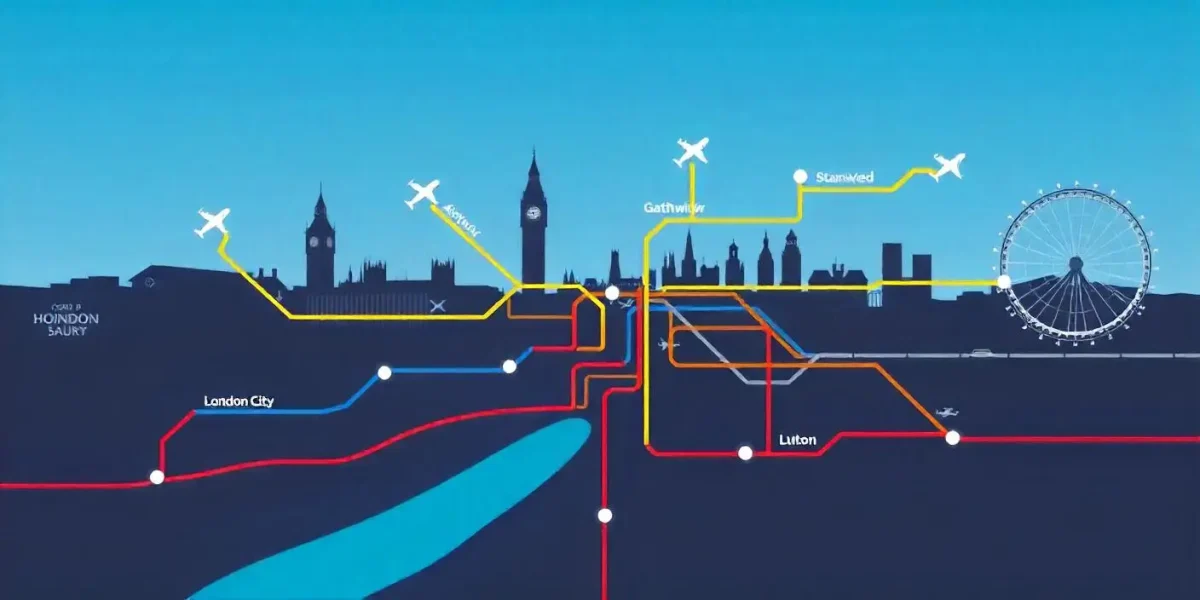
London welcomes international visitors for tourism, business and flight connections. Its airports have different routes and transport links: before choosing a flight, compare the journey from the terminal to your accommodation.
London is also a global economic and financial centre, with the City among the world’s major financial districts, and an important connection point for intercontinental flights.
Many travellers stop in London on their way to other destinations.
Tourism, business and international connections have made London a major aviation hub. The six airports usually associated with the city are spread across London and its surrounding region; they are not all within Greater London or directly connected to the Underground.
Heathrow plays a major role in long-haul routes; Gatwick combines European and long-haul flights; Stansted and Luton have a strong low-cost airline presence. London City can be convenient for the City and Docklands, while Southend offers another gateway from Essex. Flight price alone does not determine which suits you.
Together, these airports connect London with Europe, the Americas and Asia, supporting tourism and international trade.
Below are London’s six main airports and their transport connections.
Compare access by train, Underground, bus and other options. Calculate the journey to your actual London address: a fast train to a central station does not necessarily mean a fast transfer to your hotel.

1. Heathrow (LHR)
Heathrow Airport is one of London’s main airports and an important long-haul hub, connecting with Asia, the Americas and Europe. It has four passenger terminals in use: 2, 3, 4 and 5. Confirm your flight’s terminal before choosing a train or Underground route.
- Transport connections: Piccadilly line, Elizabeth line and Heathrow Express to Paddington, plus buses and coaches. Elizabeth line continues through central stations including Tottenham Court Road and Farringdon; with Heathrow Express, include the onward journey from Paddington to your final destination.
2. Gatwick (LGW)
South of London, Gatwick is the city’s second-largest airport. Its North and South terminals serve low-cost airlines and international flights across Europe and further afield.
- Transport connections: Gatwick Express and Southern to Victoria; Thameslink towards London Bridge, Blackfriars, Farringdon and St Pancras, plus coaches. The airport railway station is at South Terminal; a free shuttle connects North Terminal.
How to Get to Gatwick Airport Using the London Underground and Train Connections
3. Stansted (STN)
Stansted, northeast of London, has a substantial range of European and low-cost flights. When deciding whether an airfare is worthwhile, add the complete transfer cost and check connections for early departures or late arrivals.
- Transport connections: Stansted Express from Liverpool Street and Tottenham Hale, and coaches from several London locations. The usual rail route from Stratford requires a change at Tottenham Hale. There is no Underground service directly to the terminal.
4. Luton (LTN)
Luton, north of London, has a strong low-cost flight presence, particularly on European routes. Its access railway station is Luton Airport Parkway, which is not at the terminal: include the final connection.
- Transport connections: Luton Airport Express from St Pancras and Thameslink from several London stations to Parkway, then Luton DART to the terminal. DART has its own fare unless included in a combined ticket. Direct coaches also serve the terminal.
5. London City (LCY)
London City Airport is in the Royal Docks in east London and can be convenient for the City and Docklands. Its DLR station is beside the terminal, within TfL Zone 3. Convenience depends on your accommodation and available connections.
- Transport connections: DLR towards Bank and the Stratford International branch, connecting with Jubilee at Canning Town; buses 129, 473 and 474. Elizabeth line has no station at the airport terminal.
6. Southend (SEN)
Southend is in Essex, east of London, with European flights among its services. It has a railway station beside the terminal. Do not confuse it with Southend Victoria or Southend Central, which serve the town.
- Transport connections: Greater Anglia from Liverpool Street and Stratford to Southend Airport, plus regional bus connections that must be checked by departure. Do not rely on a direct 24-hour coach from London without a confirmed booking and route.
The linked airport guides cover connections, tickets and details to check for your journey. This page helps you compare them; consult the relevant guide before booking a transfer.
Choosing an airport according to your accommodation
Use these connections as a starting point rather than a ranking, then check an itinerary for your address and flight date.
| If you are staying near… | Connections to compare | What to check |
|---|---|---|
| Paddington | Heathrow by Elizabeth line or Heathrow Express | Terminal and price for your date; Express is not always the cheapest fare. |
| Victoria | Gatwick by Southern or Gatwick Express | Actual train fare and duration, plus the North Terminal connection if needed. |
| St Pancras | Luton by Express or Thameslink plus DART; Gatwick by Thameslink | Which operator the ticket allows and whether DART is included. |
| Liverpool Street or Stratford | Stansted and Southend | For Stansted, distinguish direct Liverpool Street trains from Stratford with a change; for Southend, select Southend Airport station. |
| The City or Docklands | London City by DLR | The route from your address and terminal opening hours; Elizabeth line does not reach the airport entrance. |
Compare the whole trip cost, not just the flight
Compare both directions for everyone travelling:
Comparable cost = flights + required baggage and extras + airport transfers + transport to your accommodation + extra accommodation if schedules require it.
Hypothetical example: a flight saving £25 per person saves £50 for two adults. If its return airport transfers cost £60 more in total than the alternative, it is already £10 more expensive before valuing the extra time. Use quotes for the same dates and conditions to make your own comparison.
Oyster, contactless and tickets have different coverage
- Heathrow, Gatwick and London City: Oyster and contactless are accepted on their main rail connections, but fares and caps depend on the service. Heathrow Express is charged separately from TfL capping.
- Stansted and Southend: Contactless reaches the airport stations; Oyster does not. Compare advance tickets and child, group or Railcard discounts with individual card payments.
- Luton: Contactless works to Parkway and on DART, which has its own fare. Oyster does not reach Parkway. Select Luton Airport when buying a combined ticket if you want DART included.
If you already have a ticket, use it at the barriers rather than starting another contactless journey. With card payments, keep the same card or device: a phone and physical card are counted separately.
Early flights, late arrivals and changing airports
Check the first or last transport for your date and direction, engineering work and terminal opening hours. A 24-hour bus route does not guarantee a departure from your stop or access to the terminal at any time. London City and Southend terminals are not open throughout the night.
If you arrive at one airport and depart from another, calculate the transfer separately: this is not a connection within the same airport. Include baggage reclaim, entry checks where applicable, travel, new check-in and security. No single connection allowance suits every flight combination; check your booking conditions too.
Last reviewed: 16 October 2026.
This entry is also available in: